
Options trading is a dynamic part of the financial market that allows traders to speculate, hedge, and earn income. At its core lies the option premium — the key factor that determines profit, loss, and strategy.

What Is Premium in Options Trading?
The premium in options trading is the price you pay to buy an option or the price you receive when you sell an option. It represents the current market value of the option contract.
For example:
If you buy a Call Option of Reliance Industries with a strike price of ₹2,500 at a premium of ₹50, it means you’re paying ₹50 × 505 (lot size) = ₹25,250 for the right to buy Reliance shares at ₹2,500 before expiry.
Similarly, if you sell (write) that call option, you receive ₹25,250 upfront — but you also take on the obligation to sell the shares at ₹2,500 if the buyer decides to exercise the option.
In simple terms:
- Option Seller → Receives Premium (Obligation, but no right)
- Option Buyer → Pays Premium (Right, but no obligation)
Components of an Option Premium
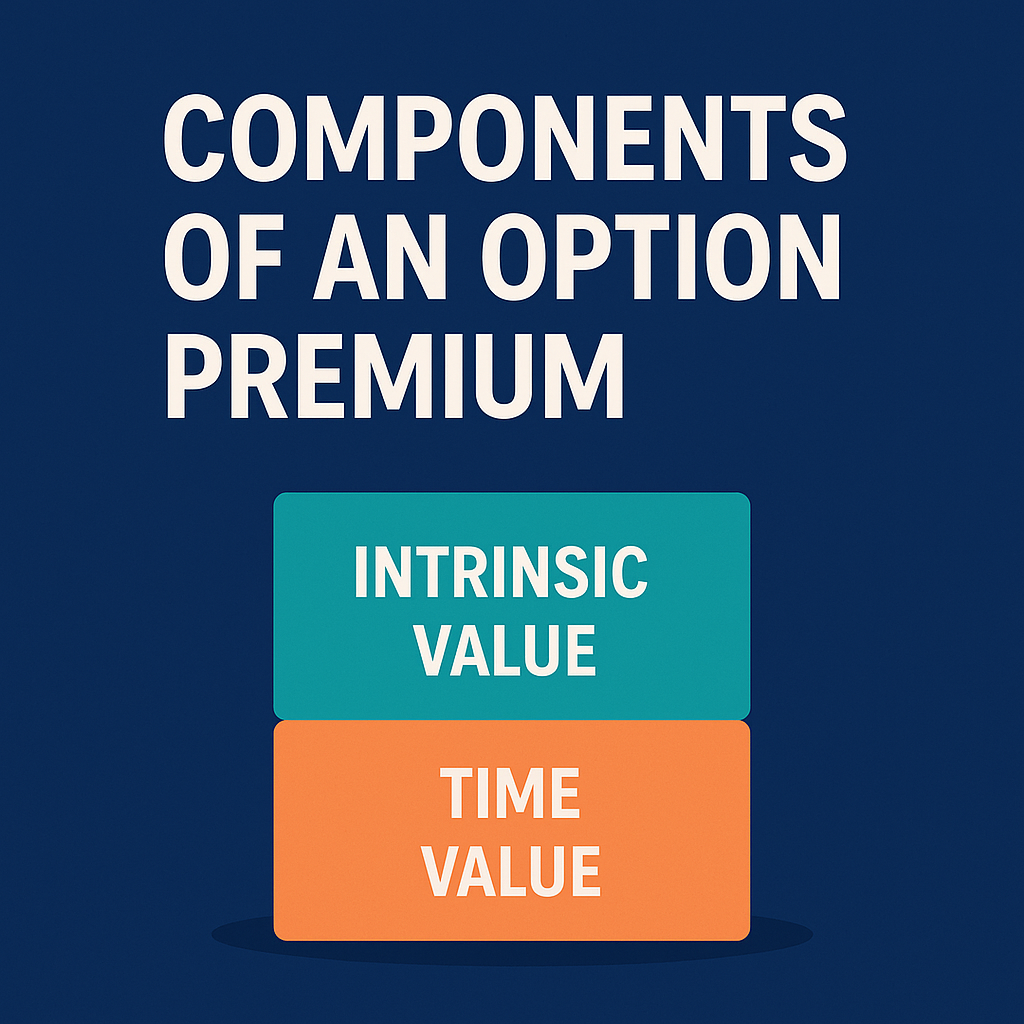
The total premium is made up of two key parts:
- Intrinsic Value
- Time Value
Let’s understand both with examples
1. Intrinsic Value
The intrinsic value is the real, tangible value of an option if it were exercised today.
- For a Call Option, Intrinsic Value = Current Price – Strike Price
- For a Put Option, Intrinsic Value = Strike Price – Current Price
If the result is negative, the intrinsic value is considered zero because an option cannot have a negative value.
Example:
If Infosys is trading at ₹1,600 and you hold a Call Option with a strike price of ₹1,550,
Intrinsic Value = ₹1,600 – ₹1,550 = ₹50
That means your option already has ₹50 of real value.
2. Time Value
The time value represents the extra premium traders are willing to pay for the possibility of future profit before expiry. It’s basically the difference between the option premium and intrinsic value.
Time Value = Option Premium – Intrinsic Value
As the option approaches expiry, the time value gradually decreases, a process known as time decay or Theta Decay.
Example:
If the option premium is ₹80 and its intrinsic value is ₹50, then
Time Value = ₹80 – ₹50 = ₹30
This ₹30 reflects the market’s expectation that the stock might move further in your favor before expiry.
Factors Affecting Option Premium
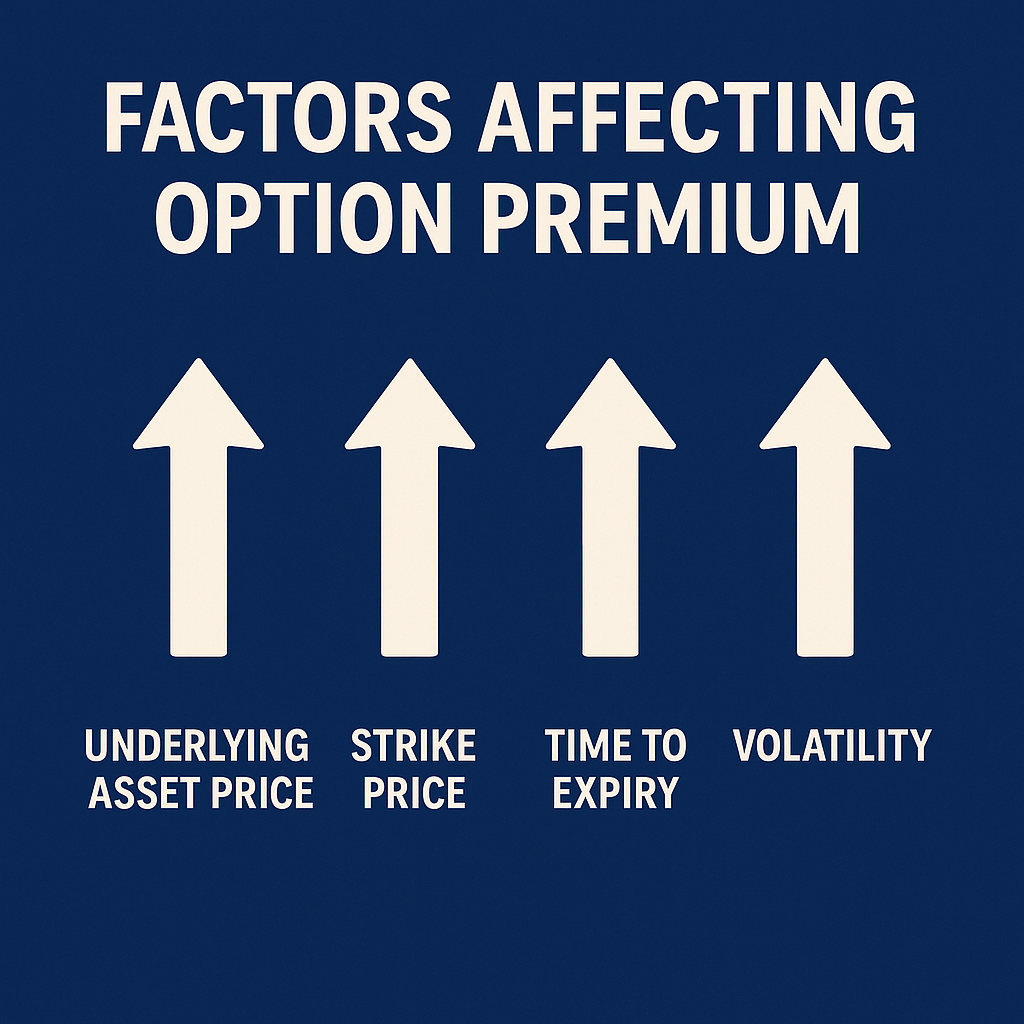
Several factors influence how the premium is determined. These are captured mathematically by the Black-Scholes model, but for simplicity, let’s break down the main elements:
1. Underlying Asset Price
The price of the underlying stock or index directly affects the option premium.
- Call Options: Premium increases as the stock price rises.
- Put Options: Premium increases as the stock price falls.
2. Strike Price
The relationship between the strike price and the current market price determines whether an option is In-the-Money (ITM), At-the-Money (ATM), or Out-of-the-Money (OTM).
- ITM options have higher premiums because they already hold intrinsic value.
- OTM options have only time value, hence cheaper.
- ATM options sit in between.
3. Time to Expiry
The more time left until the option expires, the higher the premium, because there’s more opportunity for the underlying asset to move favorably.
As expiry approaches, time value decays exponentially – meaning the last few days see the fastest decline.
4. Volatility
Volatility measures how much the underlying asset’s price fluctuates. Higher volatility increases uncertainty — and with that, the potential for profit.
Hence, higher volatility = higher premium, for both calls and puts.
This is why option sellers often avoid trading during highly volatile periods (like earnings announcements).
5. Interest Rates and Dividends
While these factors have a relatively smaller impact:
- Higher interest rates slightly increase call premiums and decrease put premiums.
- Expected dividends tend to reduce call premiums (since stock price drops by the dividend amount on the ex-dividend date).
Premium from the Buyer’s Perspective
For the option buyer, the premium represents the maximum loss they can suffer. If the market doesn’t move in their favor, the option expires worthless, and the buyer loses the premium.
However, the potential profit can be unlimited for call options and substantial for put options.
This asymmetrical risk-reward ratio makes buying options attractive to small traders who wish to control large positions with limited risk.
Example:
If you buy a NIFTY 22500 Call for ₹100 and NIFTY rises to 23000 before expiry, your profit = (23000 – 22500 – 100) × 50 = ₹20,000.
Premium from the Seller’s Perspective
For the option seller (writer), the premium is the maximum profit they can earn. In return, they take on the obligation to fulfill the contract if exercised.
Their risk can be substantial – especially for uncovered positions.
Hence, sellers typically use hedging strategies or spreads to manage risk.
Example:
If you sell the same NIFTY 22500 Call for ₹100, your maximum profit is ₹5,000 (₹100 × 50).
But if NIFTY goes to 23000, your loss is ₹20,000.
This is why understanding premium behavior is crucial before selling options
How to Analyze Option Premium Effectively
Professional traders often analyze Option Greeks to understand premium behavior:
- Delta: Sensitivity to underlying price change
- Theta: Time decay rate
- Vega: Sensitivity to volatility changes
- Gamma: Rate of change of Delta
These Greeks help traders predict how the premium will behave under different market conditions.
For example:
- If volatility is expected to increase, buying options can be profitable (Vega positive).
- If you expect time decay to work in your favor, selling options near expiry might be better (Theta positive).
Conclusion
In options trading, the premium is more than just a price – it’s a reflection of market sentiment, volatility, and time.
It represents what traders are willing to pay for opportunity and protection.
By mastering the concept of option premiums – how they are calculated, what factors influence them, and how they behave over time – traders can make informed decisions, manage risk effectively, and improve their overall profitability.
Whether you’re a beginner or an experienced trader, always remember:
“Understanding the premium is the first step toward mastering options trading.”